| |
|
9. Intro - Information processing in living organisms |
| |
9.1. Biological Neural Systems |
One of the most important parts of a neuron is its membrane,
which separates the interior and the exterior of a neuron spatially
and electrically.
A prominent feature of the cell membrane is, that it maintains
a voltage difference between the interior and the exterior.
This so called membrane potential is subject to change if a
neuron receives some input via its synapses from other neurons.
There are two basic types of input:
| |
1)
excitatory input increases the membrane potential |
| |
|
| |
2)
inhibitory input decreases the membrane potential. |
If
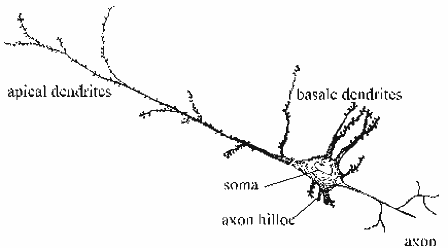
enough excitatory input accumulates the membrane potential at
the axon hillock eventually reaches a threshold. If this event
occurs the membrane follows a stereotyped trajectory, the so
called action potential or spike. This spike
travels along the axon to all its terminals which connects the
axon to other neurons (postsynaptic neurons) via synapses.
A complicated chemical process transforms the spike into a change
of the membrane potential of the postsynaptic neuron, the so
called postsynaptic potential (PSP) which comprise the above
mentioned input of the next neuron.
 |
 |
| |
Picture:
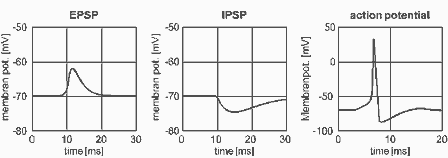
Drawing of the canonical shape of a postsynaptic potential
and the action potential. Excitatory synapses produce
an EPSP whereas inhibitory synapses produce an IPSP.
|
Source:
Networks of Spiking Neurons: A New Generation of Neural Network Models, Thomas Natschläger, December 1998 


