








Chapter in _reskin_,
editors Mary Flanagan and Austin Booth,
MIT Press, 2005
Author: Melinda Rackham
Safety
of Skin
[...] A mutual relationship based on information exchange
between avatars and hard bodied species is beautifully illustrated by
Brainscore (2002), a networked Virtual Reality 3D performance produced
by Slovenian artists Janez Janša and Darij Kreuh [Figure 9]. In Brainscore,
tracked eye movements and electrical pulses from sensors attached to the
head of the user (who remains physically constrained throughout the performance)
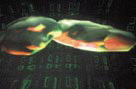
control avatars. These inputs allow the vaguely head–shaped avatars to
collect data from the Internet, which in turn alters their shape, size,
location and colour over time. The changes then affect the eye movements
and brain functions of the performer to provide a feedback loop. Here
the avatars’ coded attributes alter the users’ physiology, making obvious
the impact softspace has through its continuum into hardspace. The Virtual
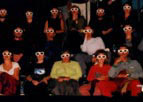
Reality environment is projected in stereo, allowing an audience to watch
the performance wearing polarized glasses. This enables them to perceive
the events in 3D, as if suspended in mid air between the two performers.
The Brainscore artists created the work to provide a new perspective on
the identification between performers and their avatars. We watch as the
flow of information moves from the performers’ physical space into the
virtual avatars’ space and than back from the avatars to the audience,
“leading the audience to perceive a concrete co-existence (as a kind of
promiscuous co-penetration) of two Realities at the same time” (Janša
and Kreuh 2002). [...]
Dnevnik, daily, 26 September 2000
The Brain Waltz
The charm of Brainscore does not lie within the aesthetic occurrence, charming colours …
One
of the possible alternatives of determining art is to define it as manifestation
of a creative genius. It is by default produced in the spirit of its creator.
In this sense, the peculiar project Brainscore can be classified among
artistic happenings, since it offers reconsideration of a new dimension
in the relationship between technology and art in a unique way.
The brain, or more precisely the brainwaves, plays the main role (beside
the computer equipment and programming) in the performance, which last
for about half an hour. The charm of Brainscore does not lie within the
aesthetic occurrence, charming colours, artistic surplus or anything similar
to that, but rather in the fact, that forms and sounds swarm in front
of us in real time; and the parameters are determined by brainwaves and
minor eye movements of both operators. The project, which is technologically
highly sophisticated and deserves admiration, does not offer anything
more than authentic experience of the three-dimensional environment, in
which more or less amorphous colourful matters tumble, to the visitor,
who is gives attention to aesthetic experience. Moderately enthusiastic
experience of the interactive visual creation, in which bioelectrical
signals rather productively cooperate with the conglomerate of hardware
and software, can charm us from the point of technical inventiveness and
the ability of the authors. They are an adequate reason for us to see
the performance, however, we are left unaffected as far as artistic experience
is concerned.
Once again, the question about the nature of modern art is raised. We
have to admit, that many artworks today (among which Brainscore can be
classified with all indulgence of postmodernism) do not function as “artistic”
– they are being perceived as such by a conscious viewer or user, since
only the story from the background, conceptual, contextual or ideological
sense make them artistic, and not the occurrence as such.
Gregor Butala
Delo, daily, 23 September 2000
A Performance of Avatars
How does someone who receives only superficial information from the field of state-of-the-art technologies, experience the performance event by Darij Kreuh and Janez Janša?
Perhaps as a (theatrical) performance of avatars, dynamic embodiments of both immobile “authors” in a virtual surrounding. A performance of “creatures” not yet seen on the “scene”. As at times a somewhat hermetic video performance of “actors” who must be taken into serious consideration when casting. Brainscore is a “spectacle” that combines a programmed environment, sophisticated technological preliminary work and a moment of surprise, live and unforeseeable action in front of the audience. Even if they are completely ignorant of the “optical” technology, bio-electrical signals and the way the Internet works, they can still follow the performance. To those who are acquainted with at least the most simple computer games, all this seems familiar, while at the same time the bustle of mimicry and the neurotic stage set of both virtual “protagonists” do arouse a feeling of slight horror – a consequence of not yet understood intensive conflict between the two “performers”.
Thus we see before us the original dramaturgy and direction
of a performance event that with elementary and authentic energy evokes
the origins of a Greek tragedy or a spectacle in general, Aeschylean separation
of an individual voice (actor) from the background (chorus) and an attempt
at cathartic articulation of basic postulates of a new, recreated ancient
Greek time.
Blaž Lukan
Mladina magazine, Rodeo column, 2 October 2000
Pilot Programme
Brainscore is a pilot performance, better
said, a programme that only just familiarizes human senses with the wonders
of cyber space, 3D picture, computer graphics and the rambling sound of
electronic noises, and for the first time in our steppes, it introduces
the act of guiding and influencing upon the course of activity in the
“artificial” parallel space by means of eye movement and brain crust signals.
As far as “the first Slovene performance that you watch with 3D glasses”
is concerned, this is a big step for Darij Kreuh and Janez Janša who,
immovable and sunk deep into armchairs, with electrodes fixed to their
heads, steer this animated dance, a remotely controlled mating of gelatine
bulk and asteroids and the grimace on stylized heads of avatars, their
representatives in space. If it seems (but it supposedly isn’t so) that
the principle of guiding foretells the time of “real” virtuality, a complete
intermediary between brain and cyber space, the feelings resemble those
that the first clients of film industry refused at the arrival of the
fatal train to the station.
Jaša Kramaršič Kacin
MASKA, Magazine of scenic art
Subtle Identification with Avatar
Brainscore presupposes interactions between the global and the local, it directs us to the connectivity of the global informational system – realised mostly by the world-wide Internet – and the local brain functioning, therefore by physics, chemistry and neuronic net facilitated by corporeal electricity. To put it simply, it is all about brains here (operators/performers) and the big brain “there”, on the information highway, and the communication between related, compatible areas in between.
Conceptually the project Brainscore undoubtedly “holds”, it is most imaginative and the equipment/program/artistic concept is demanding, since it is directed towards topics crucial for artistic interpretation of polarisation between the global and the local, artificial and natural, remote presence and presence of the physical body, corporeal identity and subtle identity of the avatar.
There are actual events and processes taking place in Brainscore; with their quantity (measurable) and quality dimensions, we witness a dialogue of two programmers involved in a poly-logue with virtual entities, which means that even a certain theatre of subtle avatar objects exists.
On the other hand, the metamorphoses of the “advancing”, ever more complex avatar are artistically imaginative. Approaching this project from the standpoint of aesthetics, the issue of avatar is most important and thus the remote presence. Subtle identifications are witnesced with virtual agents in cyber space; suddenly we (the viewers and operators/performers) are “there”, where our avatars are, which from the users necessitates a renouncing of harsh realism and a promoting of the sense for dealing with data and immaterial entities. The question of aesthetics is basically a question of perception and it undoubtedly profits the moment it does not merely deal with objects of a given nature, but also with subtle as-if objects and data manifestations in cyberspace. A new, techno-modelled perception evolves; the senses with such objects and data manifestations become sense-theoreticians. Remote presence also signifies the expanse of home, homeland. At the same time it opens ethical dilemmas: to love and honour the avatar like yourself (and, ironically speaking, even more), to protect the weaker avatars and eliminate the aggressive, dominant ones.
The
authors (together with a group of colleagues) have established a most
complex data and artistically coded universe (it belongs to the tradition
of technically more demanding ones, in Europe introduced by the Knowbotic
research group), which can serve as a platform also for new conceptual
and communicational “superstructures”. At the same time the superstructure
of this project, quite imaginatorely, presents a real educative event
from the field of cyber art in the form of workshops. The authors of the
project thus actually entered the space of artistic work and set their
hearts on its adequate perception and interpretation, which is a gesture
most characteristic of contemporary art.
... Boris Groys wrote: »An artist forms a field of communication between
the public and the object: today, as opposed to once, it is situated before
the work of art, no longer behind it.” Such a position, that which was
manifestationally introduced by Andy Warhol and Joseph Beuys to contemporary
art, is especially binding for the field of electronic cybernetic art,
which as a rule exists as a sophisticated process at the intersection
of art, new technologies and techno-science, with which also absolutely
discursive (theoretical) interventions of artists become completely sensible
and justified.
Janez Strehovec
Frakcija, Croatia / April 2001 issue
Brainscore
Among
the operators and the projection coming from the canvas towards us there
is plenty of technology. The operators are creators (like the animators
of the puppets), the true protagonists of the performance are the "avatars"
- digital puppets in the world of virtual surroundings.
"Brainscore" is a system of non-corporeal communication. Operators
communicate through the avatars, all extremities of each operator are
quiet, supported by a chair specially designed for that purpose, similar
to the dentist's. The fixation of the operator into the medical chair
reminds us of body-art performances, convinces us (like in a magician's
show) that the operators actually do not move. And being still is not
a trick here, it is a condition enabling the operator's presence of mind,
as a 100% concentration is necessary. The avatar dwelling among the computers,
is waiting for an order, and the order is being started by means of a
precisely determined brain activity. The choice of orders ("search
across a series of characteristics") is performed by directing the
view focus into a precise point on the working console. The viewing co-ordinates
are followed by a camera that enters them in the computer through an "eye
tracking" system; a move of the view in the co-ordinate system of
the working console causes in the computer the leaping from one register
to the other. The change in the brain waves noted by the EEG equipment
(electrodes sticking on the head and registering the waves caused by the
brain working), means another series of orders, which also determines
the characteristics of the chosen objects, and a number of properties
is drawn from previously prepared attributes (colour, texture, expression,
sound).
The picture coming out, a stereo effect achieved by a prepared double
video projection (separate for each eye, under a determined angle) and
by polarisation of the 3D glasses with a suitable surrounding sound equipment,
are staging elements helping the visitor to emerge in the virtual surroundings
of a communicational polygon, into the yard of the avatar. And that yard
- the communicational polygon is the message of Brainscore. It is a tech-urban
issue. Among all the worries about our uncertain future, when our fate
seems to be in the hands of a completed technology visiting us, we must
admit that we are not familiar at all with most of the developing tendencies,
with those we are sometimes fighting in a democratically quiet manner.
The example of tech- surroundings ecology (cybernetic space) the first
step of the tech-urban (in our case it is the Brainscore staff) is to
get the people acquainted with the cybernetic space. The key effort and
the problematic offered by Brainscore is not the introduction of the avatar
and the virtual surroundings on the theatre stage. The Brainscore polygon,
due to the direct communication still moving in the direction user (operator)
- computer (VR) is imminently intimate and excludes the third person -
the viewer, or rather it reduces him to an inactive spectator still not
reaching into the happening [1].
The avatars in that sense have no special ambition of conquering the theatre
stage, i.e. the theatre we know. Neither do they have the ambition of
accepting the theatrical protocol staging. When the "nuclear body"
[2] left (transcended) through
the symbolic eye pupil, it did not go into the other world in order to
find the old one, in order to behave according to those rules that govern
the bodies ruled by the law of gravity. The presence of the operator on
the scene confirms that, for after the events in the VR surroundings they
are unimportant or even disturbing - it is all leading us to the point
that a performance should be understood as a demonstration of a system
for communication without a body and the Brainscore communication polygon
in the form offered to us in that beginning - a prototype phase.
The concept behind the project is based on the constructed potential and
within the framework of the body-art of the nineties - i.e. on the theory
of the superficial-obsolete body by Stelarc. The implantation - the transfer
of technology into the body, as announced by P. Virilio, and as Stelarc
has practiced it on himself, is truly the "tendency of formation"
in the industry of communication machines here and now.
"Inter-activity produces the wrecking of the body", as Virilio
puts it. From this statement we can anticipate the importance of engaged
art dealing with the problems and the aesthetics of the body, and also
why there is interference in the technological tendencies. The glorified
couple "soul and body" has never been nearer to the moment when
it would finally be able to separate and live independently of each other,
each leading its own life. The liberation we achieve, being helped towards
the "speed of liberation", is the victory of man over nature
and the liberation of the physical laws of Mother Earth, the liberation
of the soul from the body. We will be able to include the final separation
within the triumph of the efforts of the Christian church that has educated
our civilisation in the holy reverence of that contrast.
Uroš Korenčan
###################################
[1]
In
an example of a larger production of similar mediators, in case we came
into a situation when the viewer reaches into the polygon on an equal
footing, we are naturally asking why go to the theatre when we could do
that from anywhere, e.g. with additional eye-track glasses with a screen
in the 3D technology.
[2]
Overturnment/Nuclear Body, Janez Janša; premiere
of Lepota Ekstrem II. March 1999. - a project of one of the authors of
Brainscore announces "personal avatars" - scanning the body
and visualisation of the compiled data in a digital entity that is a new
"independent" whole in virtual surroundings, filled with all
bio-characteristics of the artist; more in "Estetsko telo" -
Maska, autumn 1999.
Nifca
info, 3/01
Brainscore
Do you still remember those plastic postcards, with the grooved surface that emitted a squeaking sound when you dragged your fingernail across it? Viewed with the right attitude and from the correct angle, a three-dimensional world emerged from their postcard-sized perimeter. And do you remember stereoscopes, the View Master machines, through which images launched themselves at your eyes? They contained whole other worlds, where cartoon heroes wandered the three dimensions and tourist attractions looked as if you could walk around them yourself.
Wearing cardboard glasses, I sit and watch a virtual performance piece called Brainscore by the Slovene artists Darij Kreuh and Janez Janša. The location is the Sampo-hall of the Media Centre LUME in Helsinki. In the dark, soundproof space, the roof and the rising row of benches hide the latest super-technology with suggestive finesse. Brainscore is a performance involving two men and quite a lot of technology. The large wide screen is the actual stage of the performance, under which two artists sit, their backs to the audience, bound to their chairs. Electrodes connected to the artists' heads lead to monitors placed in front of them, on which an image of a human brain is visible projected onto both sides of the screen. The first impression is that few things would have as little in common as the techno dance of Brainscore's audience-attacking chunks and squeaky postcards or my red View Master machine. The performance that is Brainscore requires a whole lot of necessary explanation from both a technical and content-based aspect, before the whole can be fully assessed in all its complexity. And still, the experience of virtual space created by this super technology is perceived by the same senses that delight in the new worlds created by the most basic equipment.
The protagonists of the Brainscore performance are not the chair-bound artists, but the floating and rotating amorphous lumps called avatars that emerge from three-dimensional space. The role of the artists is to create these forms that live in a virtual reality, according to complex rules specially created for them. The artists control the virtual space projected onto the screen through the monitors. Messages and instructions are transmitted through electrodes and eye-controlled cursor movements onto the monitors. The movement and transformation of the avatar requires certain brain activity, here registered through the electrodes connecting the artist to the virtual space. The artist is reminiscent of someone subjected to medical tests or even of someone facing execution in an electric chair. The immobility has a clear motive, though: the men are connected to a complex system, where not only the electrical functions of the brain, but even willed motions of the eyes, can function as commands. Both require the most intense concentration on the part of the artist.
The performance attempts at a simultaneously multi-faceted - fashionably both local and global modelling of communication towards a matterless play situated in the virtual world. In addition to the brain-graphs and the motion of the performers' eyes, the virtual space and the dancing chunks are influenced by information constantly received from the chosen websites. The image of the brain visible on the screens in front of the artist is divided into five sections. Each of these corresponds with some global theme, represented in such a way that they are made up of shapes that in turn are divided into twenty objects. The objects are based on passwords extracted from the sites of anonymous hackers. The anonymous user in the form of a password denotes movement, colour, texture or sound. The objects, together with their global themes (meteorology, stock markets, transport, the media and, epidemics), form a system of communication that combines both the local brain activity of the artist with global information systems.
THE BODY OUTSIDE THE MACHINE
The performance
is called 'incorporeal', which means bodiless, even matterless. This in
turn means something that excludes or even nullifies expression based
on the corporeal. What is the role of our physical being in a non-physical
i.e. virtual world? In Brainscore, the whole psychophysical entity of
the human is represented merely by the electrical functions of the brain
and movements of the eyes. It is almost as if the body below the neck
was unable to communicate, paralysed even. In this piece the physical
person is literally bound. The notion of the body as the antithesis of
the mind - in this case technology - prevails in the heads of the artists,
because the body is not allowed onboard their virtual journey. The body
cannot be seen as a well-defined system in itself, though. Not only in
cases where the human and computer-based are spliced, i.e. cyborg experiments,
the boundaries of the physical vary in even the most basic forms of communication
technology. Even the act of writing letters or using the telephone, not
to mention email, chatting and other interactive facets of the Internet'relativise'
the physical entity and boundaries of a person. From the point of view
of communication technology, the world is limited to surfaces that penetrate
information in various ways.
Brainscore is a splash of the global tidal wave of body-image and body-culture
prominent in art and media at the end of the last decade of the previous
millennium. The Dadaists and the body art of the 1960s became relevant
in a new way. Artists commented on the position occupied by the body restrained
by a lineage of medical and scientific experiments - in an age of technology,
information and virtual realities. Orlan shaped her body through plastic
surgery and Stelarc crafted implants onto his body, allowing technology
to literally penetrate the body. On the other hand, like Brainscore, art
moved towards-and was expected to comment on -the new virtual realities
made possible by technology, where a rich and intimate dialogue was possible
regardless of the corporeal.
THE VIRTUAL WORK AS A SOCIAL ACT
Works of art that are described as immaterial and matterless have a tendency to suggest the historical distinction between the mind/body, mental/physical and the immaterial/material. A conception of the body acutely distanced from its biological and physiological realities reaches its zenith with the desire to separate the mind from the body completely. This opens up a possibility for social differentiation. Traditionally 'the medium is the message' and often the message is an elitist and a discriminating one. The virtual work of art must be seen as a political and social act. The work may be ecological, it may develop science and technology, but it may also increase differentiation and may be used for military or similar uses. It goes without saying that 'immaterial' virtual realities are the privileges of stable material conditions and circumstances. In order for a part of society to distance itself from the body and live in a virtual reality, a class of body-bound supporters and providers is required. They produce and remove matter, so that the flesh supporting the brain of the virtual citizen can survive. Brainscore shows us that, however immaterial and bodiless information appears on the outside, the more expensive and excessive the material and technological resources it requires and depends on.
THE GOOD OLD GAZE
In
the midst of all this out-of-body experience and cyborg reverie, it is
still the human body that experiences these new virtual worlds and realities.
The perception of space is entirely founded on the five senses, the dominant
ones being sight and hearing. The importance of sight has grown in proportion
with the fact that the experience of virtual space and worlds is predominantly
dependent on it. The problematics of the gaze and the act of looking disturbed
me throughout the time I was bombarded with Brainscore's particles of
information in three dimensions, not only because the act of looking and
the sense of sight are the very things that generate the gaze. The politics
of the gaze are central to any feminist theories related to the arts and
images. The image and space always has a perceiver, someone with a body
and position from which the gaze is transmitted. For the viewer, the physical
realities of the Brainscore performance - even with its temporal dimensions
created a classic camera obscura or 'darkened room' experience. Only the
eye is needed for seeing, the rest of the body is set aside. Any member
of the audience in a virtual space generated by technology becomes almost
unwillingly (I am consciously ignoring the ear) an eye, or should I say,
an eye behind reflecting, impenetrable shades. In Brainscore, this experience
is heightened by the very act of wearing cardboard glasses in a darkened
room. The eyes of the audience have to be concealed for the intimate 3D
experience to even become possible. The perceiver looks, gazes without
being seen. In this sense, Brainscore returns to the traditional way of
looking at art: the gaze reaching the work of art has no body, a dominating
gaze emanating from an undefined source. Even after having considered
the above in all earnestness I could not help to find a smidgeon of playfulness,
maybe even irony, on the stage of the performance. Human eyes, the 'windows
of the soul' of the romantics, had adopted another kind of function: the
expressionless eyes of the artists controlling the work were shown in
images on the TV monitors in the front part of the room. They didn't look
straight at you, and if they had, the response had been from a row of
cardboard glasses.
But to return to squeaky cards and View Master machines. Geoffrey Batchen
has examined virtual space and the position it holds in visual culture.
He traces the experiences generated by virtual spaces back to previous
inventions that generated similar visual experiences. The American critic
Oliver Wendell could have spoken aloud at the 2001 performance of Brainscore
and described his experience in the same words he used after having tried
the stereoscope in 1859: "a dream-like exaltation in which we seem
to leave the body behind us and sail away into one strange scene after
another, like disembodied spirits."
Anna-Kaisa
Korhonen
Translated by Jean Ramsay
Mag magazine, September 20, 2000
Incorporeal movements
Operators or actors sit in front of a large projection screen. They have three electrodes attached to theirs heads. The electrodes transmit the brain bio signals to the interface called Brainmaster. The bioelectric signals control basic computer functions. Viewers can monitor “beats” of the brain impulses on the large projection screen.
Digital cameras, which transmit images on the screen, are connected to the operators. They control and move the visual entities, which the viewers can see, with their eyes (alterations of the looks).
Virtual
world. This is an incomplete and vague description of the Brainscore project
by authors Darij Kreuh and Janez Janša. The opening will take place
on 21st September in Štihova dvorana in Cankarjev dom. The project with
the subtitle Incorporeal Communication is an interactive performance in
a virtual reality environment. It will be the first Slovene performance,
which the viewers will be able to watch with polarisation glasses. The
interesting performance was produced in the coproduction of Cankarjev
dom, KID Kibla, the Kapelica gallery and ŠOU. Brainscore deals with the
research of communication patterns and the interface enabling the human
body and the global information space to connect.
Impulses of functioning. Operators or authors of the project, Kreuh and
Janša, use the so-called incorporeal communication, which is based on
the use of brain waves and eye movement. Thereby they perform a digital
discourse in virtual space. Viewers will be able to experience visual
immersion in virtual images with the help of polarisation glasses, which
display the computer-generated events in thee dimensions.
Workshops. How to communicate without any words, the mimic and body, without
any keyboards and a mouse? How to communicate with looks and thought movements?
Authors organised workshops, which will take place in the morning, for
viewers to test such communication.
Who is who? Darij Kreuh is a researcher and new media artist. His work
comprises workshops, performances, interactive installations and virtual
reality. Janez Janša was born in Italy and he graduated from the Academy
of Fine Arts in Milan. He has lived and worked in Ljubljana since 1995.
His work includes various genres, such as installations, urban actions,
and most of all mutations of states and adaptations to new life forms.
Tadej Fius takes care of computer programming in the project. He deals
with virtual reality on personal computers and three-dimensional graphics.
Iztok Lapanja who graduated from the Faculty of Computer and Information
Science, University of Ljubljana, produced the eye-tracking system.
We are to expect a very interesting and unusual event, which researches
the use of technology and tries to discover (as art always does) new communication
paradigms and methods.
Irena Štaudohar