









Nifca info,
3/01
Brainscore
By Anna-Kaisa Korhonen
Translated by Jean Ramsay
Do you still remember those plastic postcards, with the grooved surface that emitted a squeaking sound when you dragged your fingernail across it? Viewed with the right attitude and from the correct angle, a three-dimensional world emerged from their postcard-sized perimeter. And do you remember stereoscopes, the View Master machines, through which images launched themselves at your eyes? They contained whole other worlds, where cartoon heroes wandered the three dimensions and tourist attractions looked as if you could walk around them yourself.
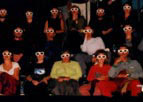
Wearing cardboard glasses, I sit and watch a virtual performance piece called Brainscore by the Slovene artists Darij Kreuh and Janez Janša. The location is the Sampo-hall of the Media Centre LUME in Helsinki. In the dark, soundproof space, the roof and the rising row of benches hide the latest super-technology with suggestive finesse. Brainscore is a performance involving two men and quite a lot of technology. The large wide screen is the actual stage of the performance, under which two artists sit, their backs to the audience, bound to their chairs. Electrodes connected to the artists' heads lead to monitors placed in front of them, on which an image of a human brain is visible projected onto both sides of the screen. The first impression is that few things would have as little in common as the techno dance of Brainscore's audience-attacking chunks and squeaky postcards or my red View Master machine. The performance that is Brainscore requires a whole lot of necessary explanation from both a technical and content-based aspect, before the whole can be fully assessed in all its complexity. And still, the experience of virtual space created by this super technology is perceived by the same senses that delight in the new worlds created by the most basic equipment.
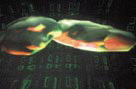
The protagonists of the Brainscore performance are not the chair-bound artists, but the floating and rotating amorphous lumps called avatars that emerge from three-dimensional space. The role of the artists is to create these forms that live in a virtual reality, according to complex rules specially created for them. The artists control the virtual space projected onto the screen through the monitors. Messages and instructions are transmitted through electrodes and eye-controlled cursor movements onto the monitors. The movement and transformation of the avatar requires certain brain activity, here registered through the electrodes connecting the artist to the virtual space. The artist is reminiscent of someone subjected to medical tests or even of someone facing execution in an electric chair. The immobility has a clear motive, though: the men are connected to a complex system, where not only the electrical functions of the brain, but even willed motions of the eyes, can function as commands. Both require the most intense concentration on the part of the artist.
The performance attempts at a simultaneously multi-faceted - fashionably both local and global modelling of communication towards a matterless play situated in the virtual world. In addition to the brain-graphs and the motion of the performers' eyes, the virtual space and the dancing chunks are influenced by information constantly received from the chosen websites. The image of the brain visible on the screens in front of the artist is divided into five sections. Each of these corresponds with some global theme, represented in such a way that they are made up of shapes that in turn are divided into twenty objects. The objects are based on passwords extracted from the sites of anonymous hackers. The anonymous user in the form of a password denotes movement, colour, texture or sound. The objects, together with their global themes (meteorology, stock markets, transport, the media and, epidemics), form a system of communication that combines both the local brain activity of the artist with global information systems.
THE BODY OUTSIDE THE MACHINE
The performance
is called 'incorporeal', which means bodiless, even matterless. This in
turn means something that excludes or even nullifies expression based
on the corporeal. What is the role of our physical being in a non-physical
i.e. virtual world? In Brainscore, the whole psychophysical entity of
the human is represented merely by the electrical functions of the brain
and movements of the eyes. It is almost as if the body below the neck
was unable to communicate, paralysed even. In this piece the physical
person is literally bound. The notion of the body as the antithesis of
the mind - in this case technology - prevails in the heads of the artists,
because the body is not allowed onboard their virtual journey. The body
cannot be seen as a well-defined system in itself, though. Not only in
cases where the human and computer-based are spliced, i.e. cyborg experiments,
the boundaries of the physical vary in even the most basic forms of communication
technology. Even the act of writing letters or using the telephone, not
to mention email, chatting and other interactive facets of the Internet'relativise'
the physical entity and boundaries of a person. From the point of view
of communication technology, the world is limited to surfaces that penetrate
information in various ways.
Brainscore is a splash of the global tidal wave of body-image and body-culture
prominent in art and media at the end of the last decade of the previous
millennium. The Dadaists and the body art of the 1960s became relevant
in a new way. Artists commented on the position occupied by the body restrained
by a lineage of medical and scientific experiments - in an age of technology,
information and virtual realities. Orlan shaped her body through plastic
surgery and Stelarc crafted implants onto his body, allowing technology
to literally penetrate the body. On the other hand, like Brainscore, art
moved towards-and was expected to comment on -the new virtual realities
made possible by technology, where a rich and intimate dialogue was possible
regardless of the corporeal.
THE VIRTUAL WORK AS A SOCIAL ACT
Works of art that are described as immaterial and matterless have a tendency to suggest the historical distinction between the mind/body, mental/physical and the immaterial/material. A conception of the body acutely distanced from its biological and physiological realities reaches its zenith with the desire to separate the mind from the body completely. This opens up a possibility for social differentiation. Traditionally 'the medium is the message' and often the message is an elitist and a discriminating one. The virtual work of art must be seen as a political and social act. The work may be ecological, it may develop science and technology, but it may also increase differentiation and may be used for military or similar uses. It goes without saying that 'immaterial' virtual realities are the privileges of stable material conditions and circumstances. In order for a part of society to distance itself from the body and live in a virtual reality, a class of body-bound supporters and providers is required. They produce and remove matter, so that the flesh supporting the brain of the virtual citizen can survive. Brainscore shows us that, however immaterial and bodiless information appears on the outside, the more expensive and excessive the material and technological resources it requires and depends on.
THE GOOD OLD GAZE
In the midst of all this out-of-body experience and cyborg reverie, it is still the human body that experiences these new virtual worlds and realities. The perception of space is entirely founded on the five senses, the dominant ones being sight and hearing. The importance of sight has grown in proportion with the fact that the experience of virtual space and worlds is predominantly dependent on it. The problematics of the gaze and the act of looking disturbed me throughout the time I was bombarded with Brainscore's particles of information in three dimensions, not only because the act of looking and the sense of sight are the very things that generate the gaze. The politics of the gaze are central to any feminist theories related to the arts and images. The image and space always has a perceiver, someone with a body and position from which the gaze is transmitted. For the viewer, the physical realities of the Brainscore performance - even with its temporal dimensions created a classic camera obscura or 'darkened room' experience. Only the eye is needed for seeing, the rest of the body is set aside. Any member of the audience in a virtual space generated by technology becomes almost unwillingly (I am consciously ignoring the ear) an eye, or should I say, an eye behind reflecting, impenetrable shades. In Brainscore, this experience is heightened by the very act of wearing cardboard glasses in a darkened room. The eyes of the audience have to be concealed for the intimate 3D experience to even become possible. The perceiver looks, gazes without being seen. In this sense, Brainscore returns to the traditional way of looking at art: the gaze reaching the work of art has no body, a dominating gaze emanating from an undefined source. Even after having considered the above in all earnestness I could not help to find a smidgeon of playfulness, maybe even irony, on the stage of the performance. Human eyes, the 'windows of the soul' of the romantics, had adopted another kind of function: the expressionless eyes of the artists controlling the work were shown in images on the TV monitors in the front part of the room. They didn't look straight at you, and if they had, the response had been from a row of cardboard glasses.
But to return to squeaky cards and View Master machines. Geoffrey Batchen has examined virtual space and the position it holds in visual culture. He traces the experiences generated by virtual spaces back to previous inventions that generated similar visual experiences. The American critic Oliver Wendell could have spoken aloud at the 2001 performance of Brainscore and described his experience in the same words he used after having tried the stereoscope in 1859: "a dream-like exaltation in which we seem to leave the body behind us and sail away into one strange scene after another, like disembodied spirits."